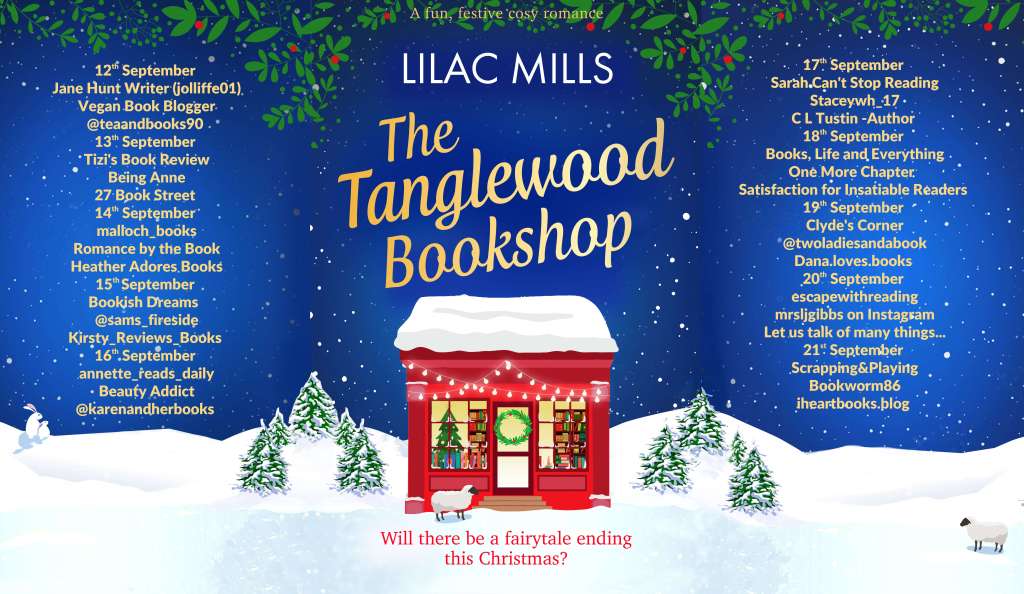
Blog Tour – The Tanglewood Bookshop

Christmas – a time to slow down, take stock and have some well earned R&R after getting through another year. Well, unless you’re Kazz Fernsby. After a streak of luck so bad that she must have broken at least a hundred mirrors in a past life, Kazz decides to wave goodbye to her cosmopolitan London life, up sticks and relocate to the quaint village of Tanglewood to start a second-hand bookshop. I wasn’t familiar with the ‘Tanglewood’ series before discovering this festive instalment, however I will definitely be making a return visit through its predecessors.

“Tanglewood might be a quiet little place, but it sure had its fair share of interesting characters.”

Tanglewood may appear the classic sleepy, picturesque village, i.e. the perfect place for Kazz to slow down and reboot, however it became quickly clear that whilst it may be quaint, Tanglewood is by no means quiet. Yes, at times, it seemed that the village may contain more resident sheep than humans, but the characters it contains have enough depth and secrets to rival the excitement and drama of Kazz’s beloved London. I loved spending time with Kazz and her fabulous group of friends, but it would be unjust to mention the feisty females of Tanglewood and not mention my favourite character – Betty. We all need a Betty in our lives. At first, she seemed the classic, slightly irritating, curtain-twitcher who lurks around every corner, keeping various hands (and ears) in everyone’s business, but as the story unfolded it became clear that she has a heart of gold and everyone else’s interests at the centre of it.

“Saul had vowed never to let another woman anywhere near his fragile heart….Was he ready to break that vow? Or would he keep the wall around his heart for the rest of his life?”

With a total career change and a relocation to be contending with, the last thing on Kazz’s mind when she moves to Tanglewood is romance. Similarly, for dashing, albeit slightly aloof, farmer Saul, love is the furthest thing from his mind this Christmas, or any time really. Once burned and twice shy, he has no intention of setting himself up for more inevitable heartbreak, that is until he is tasked with helping Kazz turn her bookshop dream into a physical reality. Betty may be my favourite character overall, but Saul Green has absolutely cemented a place high up on my list of literary crushes. Even setting aside the fact that he is drop-dead gorgeous (and appreciates the solace of curling up with a good book!) the sweetest thing about Saul is, in my humble opinion, the bond he has with the adorable, if slightly mischievous, Donald the sheep. Without spoiling the end for anyone who hasn’t finished yet, Donald does turn out to be quite the charming wingman, in an epilogue perfectly romantic and warm that it could melt the snow from the top of Skirrid Fawr on the coldest Winter day. There aren’t many men who can remain dashingly handsome whilst donning wellies, but somehow with Saul, he is even more so.

Even though ‘The Tanglewood Bookshop’ finished with such a heartwarming scene, and had all the key elements of a perfect Christmas romance, Lilac Mills knows just how to keep her readers guessing until the very end. The twists and turns throughout the plot had me furiously turning the pages in a desperate need to know what happened next, muttering the lie we all tell ourselves of ‘just one more chapter’ (or three).

“You’ve got the opportunity to try something new, so why don’t you take it? If you don’t, you’ll spend the rest of your life wondering ‘what if?'”

So, we have a gripping plot, great characters and a sizzling romance, what more could we ask for? Ah yes, a good old cup of cheer to put the reader right into the festive spirit! The only thing more picturesque than Tanglewood, is Tanglewood at Christmas. I read this book in the height of Summer, and could still practically smell the roast chestnuts and pine needles wafting out of the pages. Even reading this book in my sun-soaked garden, I felt a slight chill around my shoulders as though I were curled up in one of Kazz’s armchairs watching the snow fall outside. It may not even be Autumn yet, but I have closed ‘The Tanglewood Bookshop’ feeling so festive that I am quite desperate to put up my Christmas tree and break out the mince pies…

“The Christmas she had been dreading was now something she was quite looking forward to. Could life get any better?”

Social Media Links –

Website: https://www.lilacmills.com

Facebook: https://www.facebook.com/LilacMills

Instagram: https://www.instagram.com/lilacmillsauthor 

Twitter: https://twitter.com/lilacmills

Purchase Link – https://geni.us/TheTanglewoodBookshop

The Tanglewood Bookshop

A fun, festive cosy romance

A rural book shop. A chance to start over. But can she make her dream a reality?

Kazz used to love the excitement of her London life, but lately her passion for expensive city living has begun to wane. So when she’s given the opportunity to open a bookshop in picturesque Tanglewood, she jumps at the chance.

But village life is much quieter than she anticipated – is she actually suited for rural living? Resigned to a boring and uneventful Christmas, when she meets gorgeous Saul she is more than ready to have some fun and enjoy the festivities. If only Saul didn’t have a reputation for being a player…

Will Kazz become the heroine in her own Christmas romance, or will he love her and leave her under the mistletoe?

This gorgeous festive romance is perfect for fans of Kiley Dunbar, Rachel Lucas and Sue Moorcroft.

Author Bio –

Lilac Mills lives on a Welsh hillside with her very patient husband and incredibly sweet dog, where she grows veggies (if the slugs don’t get them), bakes (badly) and loves making things out of glitter and glue (a mess, usually).

 She’s been an avid reader ever since she got her hands on a copy of Noddy Goes to Toytown when she was five, and she once tried to read everything in her local library starting with A and working her way through the alphabet.

She loves long hot summer days in the garden, and cold winter ones snuggled in front of the fire, but whatever the weather she’s usually writing, or thinking about writing, with heartwarming romance and happy-ever-afters always on her mind.

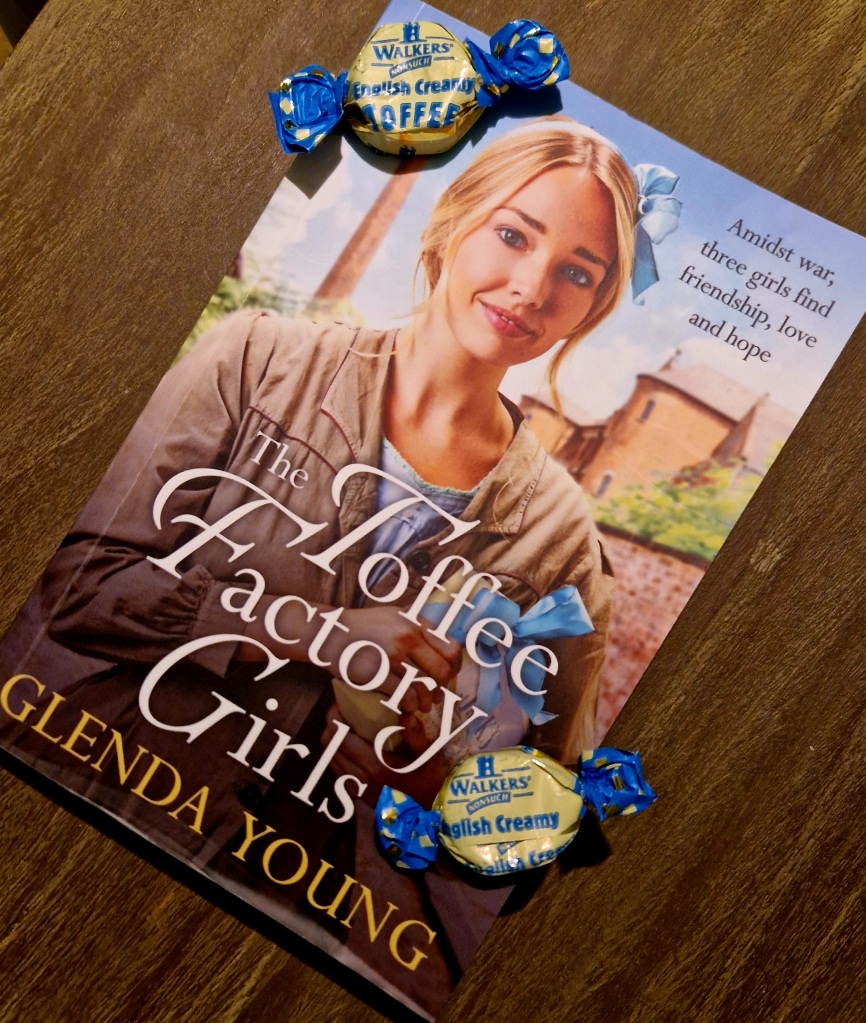
Review – The Toffee Factory Girls

Some may say I’m ruthless, reckless, a rebel. But all those ingredients, along with the best cream and top-quality sugar, go to make Jack’s toffees the best in the land.”

Chester Le Street, 1915. A war raging on longer than people had predicted, men enlisting in their masses and a huge factory in need of some order, hard work and a rebrand? Get some women in to sort it all out! Hetty, Anne and Elsie make the perfect trio in the first of Glenda Young’s latest trilogy ‘The Toffee Factory Girls’, which has all the ingredients of a gripping and un-putdownable saga; and is wrapped up with intrigue that has left me itching to know what happens next.

No-nonsense, organised Anne was my favourite from the start, but as with all of Glenda’s novels, I found myself constantly re-evaluating me opinions of each character as the story progressed. As a type-A person myself, I instantly related to Anne, but together with ditzy Elsie and dependable Hetty the three girls form a perfect blend of personalities which compliment each other, and are a force to be reckoned with when they work together. Without spoiling anything for those who are yet to read this, it became clear from early in the plot that Anne has a rich back story which I am intrigued to learn more about as the trilogy progresses. Glenda has once again mastered that fine balance of giving enough to really pique the reader’s curiosity, sending the cogs in my imagination whirring as I turned each page, but maintaining the mystery right until the end, which has left the door firmly open for us to (hopefully) delve deeper into her history next time, which I can’t wait for.

“If you want my advice, take happiness where you find it. You never know when your life will be turned upside down.”

One of the main things that I love about Glenda’s novels is the complexity of her characters. Although Anne was initially my favourite, I don’t mind admitting that I was frustrated at some of her treatment towards Hetty and Elsie at times. But, as with autonomous humans in real life, well-written characters seldom do what we want them to, or at least not consistently. Anne is exactly the type of complex female heroine that I have no doubt told Glenda exactly how her story pans out, and not the other way around! Similarly, I took an instant dislike to the somewhat immature Elsie, particularly after her early betrayal of Hetty, but through her complex personal journey throughout the story, I found myself really rooting for her by the time I closed the cover, and can’t wait to see her continue onwards and upwards (hopefully) when we see her again next time. Hetty felt, to me, like the glue which holds the group together, and could easily have become the typical passive ‘best friend’ character, who probably would have been given a back seat in favour of the more vibrant Anne and Elsie by many other authors. However, I presume Glenda is a dab hand at juggling from the way she perfectly balances all three girls’ stories with equal parts of drama, suspense and love. As a feminist it pains me to admit it, but something I really love about Hetty’s story is the bubbling romance, which is even sweeter than the toffees she wraps. But having said that, Hetty strikes me as the kind of girl who has always been overlooked. Expected to put her own wishes and feelings aside in order to support everyone around her, which is what makes her such a loyal friend, so if anyone deserves to have someone notice her and shower her with a bit of love, it’s our Hetty.

Again, as with all of Glenda’s other saga novels, the setting is so vibrant that it’s almost like another protagonist in itself. Despite being relatively local to Chester-Le-Street, I had no idea about the real factory which inspired Jack’s Toffee, but now I almost feel like I’ve been there because it’s described in such vivid detail as the plot progresses. I could practically smell the toffee wafting out of each page turn.

All in all, although ‘The Toffee Factory Girls’ has all the key elements of a typical saga – romance, mystery, feisty heroines and a rich array of background characters who swirl the plot around and keep the reader guessing until the end (and beyond), it certainly stands out from the others on the shelves. Once again, Glenda Young has taken a relatively forgotten and mundane chunk of local history, and given it a rich and exciting new life. I can’t wait to see what’s coming next for The Toffee Factory Girls, because if this first instalment is anything to go by, I know it won’t disappoint.

Review – The Widow’s Choice

“One thing I’ve learnt this past year, is that you don’t ever know what’s around the corner.”


She’s BACK! No, not just the fantastic Nancy Revell, but one of our beloved, fierce and fabulous women welders from Thompson’s.

Of course if you’ve even so much as skimmed over my earlier blog posts, it’s obvious that I (like many, many others) was/am a huge fan of ‘The Shipyard Girls series’, and was therefore waiting with baited breath to see what Nancy had for us next. No pressure there, right? ‘The Shipyard Girls’ was such a huge hit with saga readers, and beyond, so it must have been pretty daunting for Nancy to follow on from. Think The Spice Girls – yes, we eventually got ‘Spice Up Your Life’ which was an absolute bop, but when the first creative success you have is ‘Wannabe’, it’s basically impossible to immediately follow that with something equally brilliant (sorry ‘Say You’ll Be There, you just didn’t cut it for me). So I’ll be honest, I did no background research on ‘The Widow’s Choice’. I decided to approach it completely fresh, tried to put all things ‘Shipyard Girls’ out of my head, opened the pages and prepared to just appreciate it for whatever it was, whether that be another smash or something akin to that slightly less catchy second pop single. However, as always, Nancy knocked it out of the park.

Excited is an understatement to describe the moment I realised ‘The Widow’s Choice’ was a follow-on from ‘The Shipyard Girls’. Although the ‘Shipyard Girls’ saga ended with a wholly satisfying and heartwarming finale, they are all such fantastic characters that I will always have room for more of their stories. Like Downton Abbey – the series finale was completely *chef’s kiss* and tied up all the ends, but the subsequent films were like a wonderful dessert after an already fabulous meal, just like ‘The Widow’s Choice’. Having said that, however, Nancy has managed to perfectly strike that difficult balance between nods to the individual characters’ histories which thrill the familiar fans (hello Dr Eris – I spotted you towards the end!) and a rich plot which takes the reader on such an exciting and unpredictable journey that it works entirely as a standalone novel. So, if you’ve been living under a rock and haven’t read ‘The Shipyard Girls’, do not let this be a barrier to picking up ‘The Widow’s Choice’; although I would also urge you to start on ‘The Shipyard Girls’ after, because that’s equally gripping and un-put-downable.

“Angie owed it to all of them to put on a brave face and to start getting on with life again.”

So, we find our beloved Angie and Quentin four years on from VE day, and my goodness haven’t things changed! Angie has navigated the transition from coalminer’s daughter come woman welder to mistress of the manor, although I can imagine that the process of this was far from seamless, particularly once we’re introduced to Quentin’s mother Evelyn – monster in law if ever I saw one! Nancy Revell really does know how to write a baddie that we love to hate. I did wonder if Evelyn had ever come across our old favourite villain Miriam in their mutual social circles, although I dread to think of the chaos which that combination of personalities would ensue. The phrase ‘folie a deux’ springs to mind.

Although she is lady of the manor now, I was quickly relieved to find that our Angie hasn’t changed too much. She may be far from the impulsive, fun-loving and carefree girl we met several years back, but she certainly hasn’t forgotten her roots. When tragedy strikes in the opening chapter, Angie is understandably distraught and has the wind well and truly knocked out of her sails. But, with her motley crew of younger siblings in tow, as well as a spirited toddler of her own in the mix by now, the support of the eclectic mix of household staff and a fabulous new friend Clemmie (who even gives our Dor a run for her money), she rises to the challenge and, of course, comes out on top. And, in classic Nancy Revell saga style, does so with a new romance so fiery leaves even the draughtiest corners of mid-Winter Cuthford Manor, toasty warm.

I’m already counting down to the next installment, and can’t wait to see what Nancy has planned next for Angie and her tribe!

Nancy Revell’s books are enjoyed by all ages in this family!

Review – Mistletoe and Mulled Wine at the Christmas Campervan

“Whatever was to come, she was determined to make this festive season a special one.”

Few things in life bring me as much comfort and joy as the Northumberland Coastline and Christmas. So, when I stumbled across ‘Mistletoe and Mulled Wine at the Christmas Campervan’ on a snowy Saturday afternoon in my local library, I couldn’t believe my luck. And not just because I was slowly losing my mind after six consecutive readings of ‘Peppa Pig’s Christmas Wish’ to my toddler. Although there are many, many things I could say about my feelings on Peppa Pig, I would far rather discuss my excitement at having discovered Caroline Roberts’ ‘Cosy Campervan’ series.

As a type-A person who craves order and logical routine, it’s totally not my style to have started a series part way through, however I didn’t initially realise that this was not the first in the series, or a standalone novel. In the chaos of managing a toddler in the library and my excitement at having found the rare gem that is a book set in the North East, I didn’t look too far into this. However, the author manifested such intricate character depth that made this work entirely as a standalone festive read, but sprinkled in enough gentle nods to characters’ personal histories that my curiosity has definitely been piqued and I fully intend to read the previous instalment next. What was it that made Jack settle down? Was Lucy enough, or were there other factors at play? I need to know!

As an objective reader who has no knowledge of this book’s predecessor, I felt that Jack and Lucy have such a natural, instantly recognisable chemistry that I didn’t have any reason to initially question how their relationship had blossomed, although I have to say I wasn’t entirely trusting of him at first. Whether this was intentional, or perhaps a nod to the previous book in this series, I don’t yet know, but I wanted to write up the review and share my thoughts before confirming or denying my theories as to what happened to make Jack into such a flight risk, particularly around what happened with Lucy’s best friend Becky, whose opinion of Jack is as ice-cold as the North Sea on a windy December night. Watch this space, because I am certainly intrigued.

After a plot with as many peaks and troughs as the Cheviot Hills however, I had most definitely warmed to Jack by the end. Without spoiling any plot elements for anyone who hasn’t read this book yet (although you really must), his grand romantic gesture against the backdrop of the breath-taking coastline had me smiling into the pages. And, when you consider the fact that he’s hobbling through it due to being, not quite in his usual peak physical form, shall we say, the love which fills this climactic scene would melt even the coldest cynic’s heart.

I can’t believe it’s taken me so long to discover Caroline Roberts’ charming series; as a North East reader it’s almost embarrassing! Although after mentions of Bamburgh Bangers and The Muppets Christmas Carol, I did feel slightly paranoid that this author had somehow generated a book which is able to listen to your conversations and tailor the text accordingly like a smart phone, because at times it was like she had been inside my head.

All in all, I thoroughly enjoyed spending part of the festive period at Cove Cottage. Northumberland is my favourite place in the world, and between the mania of Christmas preparation and parenthood, it’s rare I get the chance to spend time there in the festive period, so it was an absolute treat to be able to go there in mind, if not yet in body, this year. My favourite part was being able to spend the night in a lavish castle, with roaring fires in the midst of a snowstorm and feeling like an extra in Downton Abbey; but the Christmas glow was practically shining from the pages throughout the book as a whole. Between the smells of the freshly baked festive treats in the village cafe, sights of the twinkling lights in the picturesque villages (‘The Holiday’, eat your heart out!) and snuggling up by the tree with gorgeous Daisy the Daschund, ‘Mistletoe and Mulled Wine at the Christmas Campervan’ has certainly got my festive spirit….all fired up!

Review – The Sixpenny Orphan

“The future was full of possibilities, making her mind race and her heart soar.” 

We all know that Glenda Young has asserted herself as one of the main faces in the saga genre. When I pick up one of her books I don’t even need to read the blurb as I know I’ll be hooked from the start; frantically flipping the pages with baited breath, desperately needing to know what happens next. Of course, ‘The Sixpenny Orphan’ was no exception.  

One of the reasons I love Glenda’s saga novels is her consistent ability to write amazing heroines who overcome huge adversity, have incredible strength and both inspire and humble the reader; although this time, she truly outdid herself by giving us not one, but two! My initial prediction when I realised this story was one of two sisters, was that there would be a typical ‘good’ and ‘bad’ one, the latter of which I would love to hate. However, as Glenda does so often, she took what could have been a typical saga plot and broke away from that mould, putting her own unique spin on these characters. Although we quickly learn that Poppy is the slightly more outspoken of the two, I was surprised and pleased as the story progressed and the complexity of both characters began to unfold as the chapters (and years) went by, with both Poppy and Rose having strengths and flaws which were unique to each of their multi-faceted personalities.  

I wouldn’t say I had a favourite between Poppy and Rose, since both had their own, equally rich and intriguing personal histories, but one aspect of the overall story which really stood out to me was Poppy’s struggle to balance meeting the needs of her children, husband and sister; to say nothing of her job and responsibility of running the house. Some feelings simply transcend eras, and the overwhelm which comes from meeting the emotional needs of everyone around you whilst carrying the mental load for the household as a collective, is a feeling shared by mothers, or ‘default parents’ everywhere. A great deal of Poppy and Rose’s struggles were, although very emotional, quite unrelatable for a typical 2023 reader, most of whom simply cannot comprehend that level of poverty and inequality, but the emotionally drained mother trying her best to do it all is a feeling which struck a cord with me, and probably many others, instantly.  

Glenda has an amazing ability to write inspiring heroines who we are all rooting for, but what ‘The Sixpenny Orphan’ really highlighted for me is Glenda’s aptitude for writing truly incredible leading men. I have touched on this before, but the character of Sid really emphasized this for me. The world of fiction is absolutely littered with dreamy, idealistic men, but being able to create one which has appeal within the context of a mining village in 1919 is no easy task. In a time and social context where women and men had very clear roles, defined both legally and culturally; decades away from women having the most basic of rights such as their own bank account (which is ridiculous when we consider the fact that most, if not all, of our Ryhope heroines work in some capacity, but the patriarchy never did make sense to me), it must have been incredibly hard to write a man who is appealing to a 2023 audience and yet still believable in the context of the plot. Of course Glenda nailed this though, and our lovely Sid embodies all the qualities we want in a modern man; he’s supportive of Poppy’s dreams, values her family and is a relatively hands-on dad (a term I despise), but is still very much of his time in that we still wouldn’t trust him to make a batch of soup or to tackle the mammoth task of laundry day. But, when it really matters, he is wholeheartedly there for Poppy and her sister. Not that she needs him of course, because like the rest of Glenda’s heroines, she is more than strong enough to face the world on her own, even more so with her sister.  

“I daresay you can cope with anything life chucks at you.”

Similarly, I really enjoyed the glimpses we had into Ambrose and Ella’s relationship. Although secondary characters, it was moving to see how Ambrose truly sees Ella as his equal and values their business as a joint venture; another modern man like our Sid. I like to think that seeing this relationship at an early age (even when she was being told off) is what taught Poppy that she shouldn’t settle when it comes to her own choice of husband. A lesson which, thankfully, Rose eventually seems to learn too. Some of our Ryhope heroines weren’t quite able to get the measure of the right man, but Poppy especially seems to know what she wants and isn’t prepared to settle. It’s not often I celebrate the male characters over the females, but the world could definitely use more Sids and Ambroses!  

Another thing which I particularly enjoyed about ‘The Sixpenny Orphan’ was Lil Mahone’s redemption arc. For those of us who have followed Glenda’s Ryhope sagas up to now, Lil has become the one we all love to hate; her gossip might help to move a plot along nicely from time to time, but I would really hate to know her. Although, having said that, I think every street has a Lil Mahone in some form; and she would absolutely be the diligent, Karen-esque admin of her local village Facebook group if she were around today.  

All in all, even though I’ve had many, many visits to Glenda’s world of 1919 Ryhope, she continues to churn out fresh characters and plots which make the stories of this familiar village feel like we’re visiting for the first time. The only thing I was left wanting more of from ‘The Sixpenny Orphan’, is Rose’s story. I would be so interested to read this same novel written from Rose’s perspective, to really get into how things felt from where she stood.  

Blog Tour – A Mother’s Christmas Wish

“It was true she had fire in her belly, a lust for adventure and a craving for excitement that she knew she’d never find living in a small village.”

I’ve read all of Glenda Young’s books so far, and I maintain that it’s impossible to pick a favourite, but if I had to; then this one would certainly be a strong contender. Cakes, Christmas and a whole lot of smashing the patriarchy – what more could you possibly want in a saga? Although it would be hard to choose a favourite book of Glenda’s so far, Emma is without a doubt my favourite character she’s written. Don’t get me wrong, I love all of our hardy Ryhope lasses who conquer their fears and overcome huge obstacles to find their inner fire, but what particularly charmed me about Emma is how she arrives in Ryhope with her fire already blazing; perhaps a little too brightly! At first, as much as she made me chuckle, I didn’t really feel sorry for her in the way I usually do for the heroines Glenda writes. Even though it gets her into some sticky situations, I love how Emma seems to just let whatever ideas or observations pop into her head fly out of her mouth or transpire into action with absolutely no regard for the consequences. I suppose the polite way of saying it is that she has no filter, and I can’t imagine why I would relate to someone with that particular ailment (although I’m sure my husband would have a theory).

So, after bursting into Ryhope with a somewhat colourful entrance, Emma has the reverse journey of the heroines who have come before her; gradually learns to see things from other people’s perspectives and, thankfully, fine tunes her ability to judge other people’s characters, realising that there is often more to people than what is apparent on the surface. Similarly, I quite enjoyed seeing Emma’s leading man’s journey from a brooding, rude and somewhat of a Marmite character to a dependable, thoroughly wholesome and definitely fanciable type. He’s also somewhat of a modern man, almost feminist in his support for Emma and her leading ladies which I really loved. Of course I won’t name names for anyone who hasn’t read it yet, but it was an interesting twist between Emma’s character development around becoming more balanced and less led by her emotions, and him learning to push through his instinct to be cautious and fear of feeling anything too deeply. By the end, they were balancing each other out perfectly.

“Being with him made her feel free in the same way as she felt roaming the hills above Loughshinny.”

I’ve made no secret of my desire to have a spin-off novel where all of Glenda’s feisty heroines unite and take on the world together. So, I was absolutely thrilled to see all of them getting together in the final chapters for Women’s Christmas (a tradition which I will certainly try and implement in my family; as the one who usually gets lumbered with cooking the dinner it seems only fair!). Emma’s story is also set a few years later than our other heroines’, so it was very nice to see that they are all still settled and thriving in Ryhope by 1923. As if we would expect anything less from these fearless females, though?

“Ryhope becomes a part of your very being. It embraces every part of you.”

As always, my only criticism of Glenda’s saga novels is that I want more. I’m a glutton for the triumphs and tribulations of her feisty Ryhope heroines and my need to know what they get up to next will never be satiated. But, ‘A Mother’s Christmas Wish’ has left me feeling more than sufficiently festive, itching to hear my boots crunching in the snow and peckish for some apple cake (even though I’ve never actually had it) – so any recipes would be greatly received!

Glenda Young credits her local library in the village of Ryhope, where she grew up, for giving her a love of books. She still lives close by in Sunderland and often gets her ideas for her stories on long bike rides along the coast. A life-long fan of Coronation Street, she runs two hugely popular fan websites.

For updates on what Glenda is working on, visit her website glendayoungbooks.com and to find out more find her on Facebook/GlendaYoungAuthor and Twitter @flaming_nora.

UK – https://www.amazon.co.uk/Mothers-Christmas-Wish-heartwarming-sacrifice-ebook/dp/B09GFHCKBP

US – https://www.amazon.com/Mothers-Christmas-Wish-heartwarming-sacrifice-ebook/dp/B09GFHCKBP

Review – The Cottingley Secret

“Possibility is where all the best stories begin.”

Hazel Gaynor could write flatpack furniture instructions and they would still be utterly enchanting; I honestly cannot find the words to do justice to her ability to make stories come alive. As has been the case with her other novels I’ve read thus far, I didn’t read ‘The Cottingley Secret’, I lived it. Or at least, it certainly felt as though I did. This was absolutely not a novel I could dip in and out of between appointments or on lunch breaks; as soon as I opened the pages I was totally consumed by the characters and their unique journeys. Put simply, if I’d read this while running a bath, my house definitely would have flooded.

My knowledge of the Cottingley fairies was pretty limited before reading this re-telling; like most people, I’d seen the photos at some point but never really known the story behind them. I vaguely remember seeing the film adaptation in the 90’s, but even that memory is quite hazy now (especially as I am reluctantly beginning to accept that the 90’s were 30 years ago and not 10 as I often still think they were). If anything, however, that possibly made this story even more enthralling for me. I first discovered Hazel Gaynor’s novels through ‘The Lighthouse Keeper’s Daughter’, which reimagines the story of a really significant part of North East history and was therefore close to my heart, and also thoroughly enjoyed ‘The Girl who Came Home’ set around the Titanic, an event which we all have some knowledge of, but having limited knowledge of the ‘real’ events made me feel so much more connected to the characters. For once, I had no desire to google every detail and compare this retelling to the story of the ‘real’ fairies because I knew Hazel’s version is the one I want to believe is true.

Having said that, for the few aspects of the story I did google in vain attempts to pacify my own curiosity, even though I knew some parts were products of Hazel’s imagination and arose from the need to advance plots or fill in gaps in the real story, she intertwines fact and fiction so well that it becomes extremely difficult to separate the two. The story of the Cottingley fairies is already a pretty solid base for an exciting and spellbinding story, but Hazel’s imagination is like adding petrol to the low embers of a bonfire and giving the reader an absolute inferno of intrigue and excitement.

It must be difficult enough to tell one story, with the complexities of character depths and managing plot progression, but again Hazel Gaynor has taken that challenge and raised it with another story interweaved through the original so neatly that they’re knitted together like stripes in a jumper. The story of the present-day Olivia embarking on a new adventure despite her heart-breaking personal losses, whilst running the bookshop of all of our dreams, had enough emotion and intrigue to be a standalone contemporary fiction novel, but using this as the lens through which we discover Frances and Elsie’s secrets means we’re gifted with two incredible stories for the price (or three-week library loan in my case) of one. Personally, I found both stories equally gripping as well, something I find quite rare in these novels which flit between past and present; usually I develop a clear preference for one story after a few chapters and find the parallel story an irritating inconvenience but that couldn’t be further from how I felt whilst reading ‘The Cottingley Fairies’.

My ever-sceptical husband did ask me, whilst I was about half way through ‘The Cottingley Secret’ why I was reading a fantasy book when this isn’t usually my genre of choice, and why I was so invested when, quote, ‘they’re obviously not real’ but, in a way, are any books real? Every time we crack the spine of a novel we’re entering someone’s world of fantasy and make-believe. And, the key question with the Cottingley fairies is not whether the photographs were real or faked, but whether you choose to believe.

“There’s magic in every bookshop, Olivia. You just have to bring people to it. The books will take care of the rest.”

Review – Curtain Call at the Seaview Hotel

The Seaview had weathered many storms, but she felt this one might be her trickiest yet.

Rain pelting the windows, the toddler finally snoring beneath his cot blankets upstairs, candles flickering on the fireplace – surely nothing could make this moment any more cosy, I hear you say? Wrong. My sense of pure comfort more than doubled as I cracked the spine of ‘Curtain Call at the Seaview Hotel’, and checked in to my favourite beachside B&B. Although Glenda Young’s cosy crime series is definitely best enjoyed snuggled up by the fire on a rainy Autumn evening, I found both instalments so atmospheric that I really believe I could have read them in the Maldives (a girl can dream), and still felt the misty sea fret dampening my face and the aroma of fish and chips wafting up from the pages just as strongly.

I’m not usually much of a crime fiction lover, (it can be somewhat of a busman’s holiday for me) but since I always thoroughly enjoy Glenda’s historical sagas, I checked ‘Murder at the Seaview Hotel’ out of the library during a rare few days off work and was hooked straight away. I was so late to this party that I read the first instalment only weeks before ‘Curtain Call at the Seaview Hotel’ was released; which worked out great in the end as I got double the intrigue without the impatient waiting period between publications.

With characters as complex and mysterious as the plot, I’m not sure how I became so invested in their stories after only a couple of chapters; but that’s the caveat of Glenda Young’s gripping storytelling; just as I start to have the characters worked out, there’s another intriguing twist which has me suspicious of everyone and second guessing myself. So, my decision to try this series in an effort to fill some spare time on days off quickly spiralled into “surely it will be resolved in the next chapter, just a few more pages before bed” and the inevitable cycle of frustration and the unrelenting need to find out what happens next; more commonly known as ‘the binge read’.

As I’ve said, crime novels can be a bit of a busman’s holiday for me, but I’m almost embarrassed to admit that, in neither ‘Murder’ or ‘Curtain Call at the Seaview Hotel’ was I able to correctly guess the murderer. In fact, on both occasions I was completely flabbergasted as I’d formulated totally different theories as to where the plot was going to progress; which again is a testament to Glenda’s talent for creating plots which are even richer than Jean’s home made chocolate cakes. Being so well established in the saga genre, it was no doubt a nerve-racking move for Glenda Young to branch out into cosy crime but I’m delighted that she did. Both instalments were equally as gripping, with the second possibly even more so since the characters were, by then, more well established which allowed her to delve further into their personalities and back stories, forcing the reader to question everything we thought we knew about these now familiar faces.

As much as I’m desperate to check into the cosy Seaview to join Helen in her exploits, and of course to pet good old trusty Suki, I don’t know if I could handle the stress. With the amount of plot twists which emerge so subtly I hadn’t even the slightest anticipation before they were hitting me in the face, I can only imagine the anxiety Helen must feel dealing with these every day. Of course, with a location as atmospheric as the Seaview and friends as wonderful as Sally and Jean I can see why Helen soldiers on through it and, even speaking as a vegetarian, I can say with confidence that I would definitely risk a night or two under the same roof as a murderer if it came with the promise of one of Jean’s full English breakfasts…

Farewell, Shipyard Girls!

We all have certain stories, certain characters or worlds which stay with us long after we’ve turned the final page. ‘The Shipyard Girls’ may appear to the objective observer as a typical saga series (a very well-written and addictive one at that), but for me this series marked the start of my first ‘proper’ writing experience; the first time someone other than my immediate family or friends (i.e. someone not morally obliged to) told me that I wasn’t terrible at it. I was a little bit late to the SYG party, but a couple of months after binge reading the first three books on holiday, I found myself between jobs and a bit unsure of the next steps. With a decent stretch of spare time on my hands for the first time in years, I decided to start writing. On the advice of a friend who had had some success, I began by writing about things I enjoyed and so, this saga series which I couldn’t put down seemed a logical place to start. When I received an email from Nancy herself to say she really enjoyed one of my reviews and asked if I’d like to be part of the next blog tour, I couldn’t believe it – a proper, successful author liked something I’d scribbled together on my ancient laptop one rainy afternoon.

I had no idea where my writing journey was going to go, and as evidenced by my completely sporadic and random postings on this blog, I still don’t. But the main constant since I started this page has been regularly scheduled hype about the latest SYG instalments and gentle background encouragement from Nancy. Since joining the club of SYG bloggers and having the privilege of getting to know Nancy, I’ve had three more career changes (I never was able to focus on one thing for too long) and become a parent; none of which has even slightly resembled the life plan I had in mind at the time I started blogging. Which, is what made it especially poignant to be alongside the girls as they all ended this chapter of their journey in preparation for embarking upon their next unique and exciting steps.

“Life, she had learnt, was lacking in certainty, and sometimes it ended up sending you down a different route to the one you had intended or wanted to take. Sometimes…those unexpected turns in life led to something rather special.”

I’ll admit I was nervous to start ‘Three Cheers for The Shipyard Girls’, partly because, as with all of the readers who have loved this series, I didn’t want it to end but also because I was really apprehensive of a potentially rubbish ending spoiling the rest of the series. It’s strange to think that we (as readers) have these particular series and characters that we really love, which are a result of a particular author’s imagination, and yet we seem to have no faith whatsoever in their ability to take the stories where they need to go. I genuinely felt under pressure as I started to read Three Cheers, and was quite fraught about whether Nancy was going to do our girls justice; so I can only imagine the anxiety which the prospect of ending such a well loved series caused her! Of course, as always, she absolutely nailed it.

My prediction for ‘Three Cheers’ had been a final epilogue with a flash forward to the girls with their granddaughters at the 2020 VE day anniversary celebrations (obviously in a perfect universe where coronavirus didn’t exist), mainly so that I would get to find out where life took all of them but actually, the ending Nancy gave us far surpassed this. Really, the ending of ‘Three Cheers’ felt like a beginning, with all of the girls parting ways to embark on the next stage of their lives and all being exactly where they should be; their collective journey having been completed and now fragmenting into individual, enthtalling stories just waiting to be written. The imagination of the reader as to where our girls might end up after they’ve taken these next steps takes their journeys so much further than any author (even Nancy) could. Even as an avid SYG reader myself, I can’t specifically whittle down where I want each of the girls to go in life; so the possibilities being conjured up by the individual readers’ minds are boundless. Just imagine the fan fiction spin-offs we could end up with!

As sad as it is to know that I won’t have any more exciting anticipation of new SYG books, I will certainly be re-reading the previous ones from time to time to catch up with my old friends and reminisce of our adventures; and I don’t mind admitting I’m glad to have finally shed the anxiety of Helen and Dr Parker’s infuriatingly inconsistent ‘will they, won’t they?’ drama. And, it’s comforting to know that we’ve left each of our girls at the exact right place for them to embark on the next passage in their lives (including Miriam – if you know, you know) but, if the day ever does come for an on-screen dramatization then Nancy, you know where to find me. As a Mackem lass who grew up within spitting distance of Tatham Street, I can think of nobody more befitting of a cameo…

Recent Reading Roundup – December

The Girl Who Came Home – Hazel Gaynor


I discovered Hazel Gaynor a while ago and absolutely devoured ‘The Lighthouse Keepers Daughter’, but somehow never got around to reading any of her other work until now. Titanic is one of those events which has been told and re-told so many times, especially in the historical fiction/saga genre that it is hard to make it fresh. However, as with ‘The Lighthouse Keeper’s Daughter’, Hazel Gaynor has a really unique ability to take factual events and sensitively intertwine fictious plots which breathe fresh life and emotion into already familiar stories, rendering them like an entirely new plot to even the most well-read historian. The story of the Addergoole Fourteen is one I’d strangely never come across despite (like everyone) having seen umpteen films, documentaries and novels about Titanic; and again Hazel Gaynor strikes the almost impossible balance between respecting the real-life characters’ personal journeys and adding her own creative flair to fill in the blanks which history has left and enrich their stories for the reader. I will certainly be making my way through more of her back catalogue when time allows!

Suffragette Girl – Margaret Dickinson


Obviously I love historical sagas and all things feminism, so there was no way I could have walked past this when I saw it in my local library. I will admit that I was initially taken aback by the prologue taking place in the 1930’s, and a bit confused as to how it could possibly link to pre-WW1 suffrage, but the plot was so multi-faceted that, before I knew it, I was following the characters into the 1920s and still wanting to know more about where their journey would take me. I did find the pacing a little bit fast for my taste, but this didn’t occur at the expense of any individual character development, I just would’ve enjoyed delving deeper into the shorter term milestones of the characters’ lives rather than skipping to bigger events which take place many years apart. That said, I do think this story had enough layers to it that it could have been a two, or potentially even three, part saga as it has definitely left me wanting more – which I suppose is the mark of any great story!

Skipping Christmas – John Grisham


On the hunt for some more specifically festive reads which don’t include a single woman finding love where she least expects it in a country village over Christmas after having her heart broken in the big city, and as a fan of ‘Christmas with the Kranks’, I was very much looking forward to this. As a footnote to that last point, there’s nothing at all wrong with chick-lit, I love chick-lit, I just don’t personally love Christmas chick-lit. I find good, standalone, Christmas stories quite difficult to find if I’m honest – Dickens really has the market on that one doesn’t he? Anyway, I did the strange and taboo thing of reading the book version after being familiar with the film, but in my defence it was only recently that I was made aware that this story was a book first. I was a little bit disappointed that some scenes and even dialogue were word for word the same as the film version, but then again I complain if “film versions” differ even slightly from books I’ve enjoyed so I suppose there was no winning either way in this scenario. I did however really enjoy the difference in Nora and Luther Krank from the “film version”. If I’m honest, the book makes a little bit more sense and the plot is more believable than the film – Nora in the film never seemed very sold by the whole scheme and I never quite understood why she got on board in the first place, but I found the Kranks’ literary counterparts much more united and a little bit more likeable in that sense; I was really rooting for them to have their Christmas-free holiday whereas in the film I always find the portrayal much closer to the stereotypical “grinch” dad and overly festive, motherly housewife. A testament to why the “book version” is literally always better.