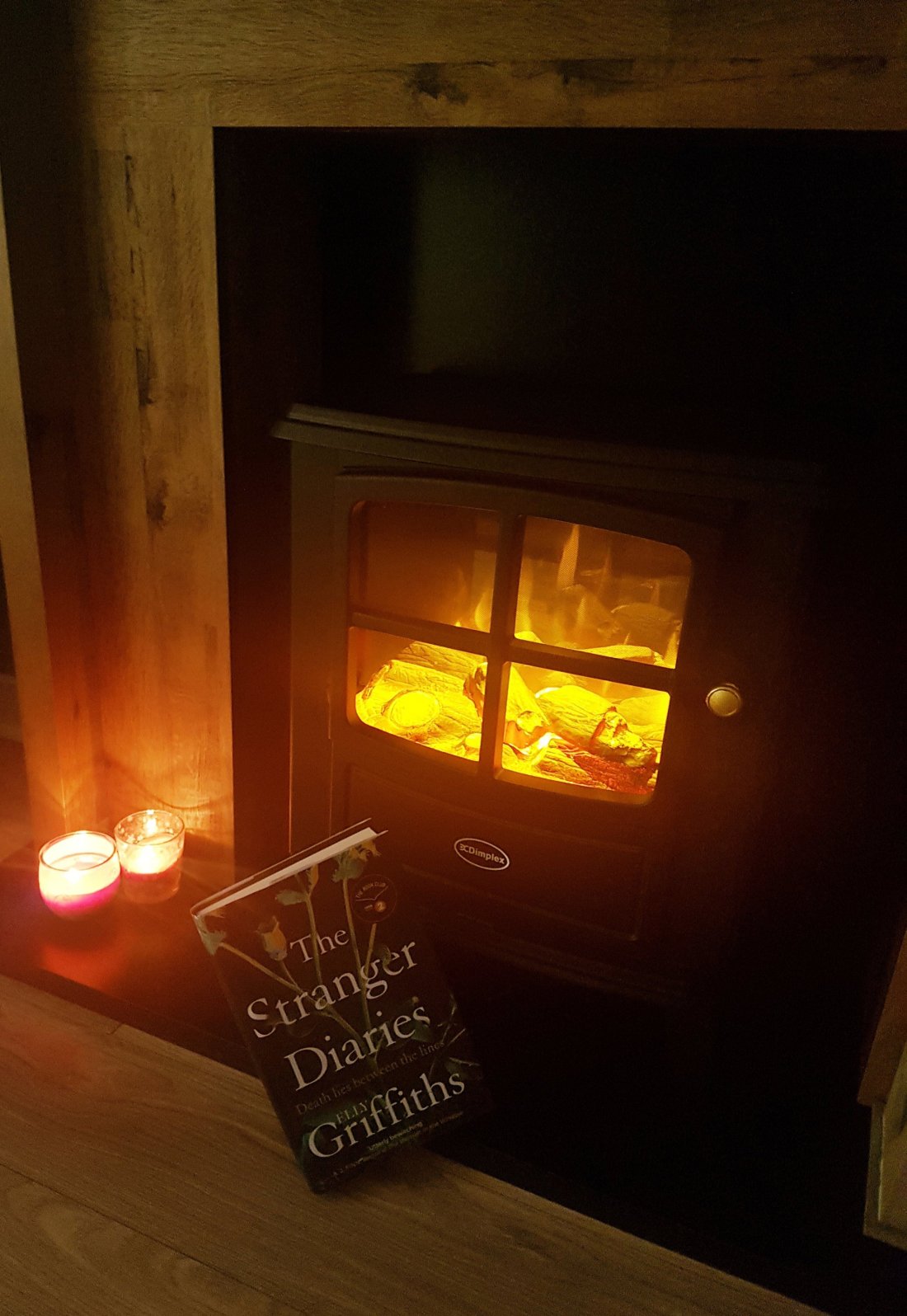
Review – The Stranger Diaries

Ah, the Waterstone’s January sale, how I love thee. Said sale was so good this year that I actually bought hardbacks! I never buy hardbacks; they hurt to hold, they look ugly on the shelf and the dust jacketsalways slide off – it’s a no from me. However, I’d had my eye on this Elly Griffiths gem for a while so was beyond thrilled to have found it half price. I went into The Stranger Diaries (TSD) with mixed feelings; I am a huge (probably too much so) fan of Elly Griffiths’ Ruth Galloway series, but I tried her Stephens and Mephisto series and just could not get into it. So, I assumed this standalone novel would be like either one of the above, a literary Marmite, if you will. And I’m pleased to say that, much like actual Marmite, I loved it.

For existing Ruth Galloway fans, it was very Galloway-esque (is that a word?) so of course I was completely invested by chapter two. Clare Cassidy is very much a less likeable Ruth Galloway, she’s very middle class and somewhat of a loner when she isn’t teaching but you do find yourself wondering why something seems slightly ‘off’ about her. Of course, with this being an Elly Griffiths, I trusted nobody until the very last page. The thing I really love about Griffiths’ work, which was absolutely the case with TSD, is that every character, no matter how insignificant, has a rich history. Not only does this make you care about what happens to the characters and their individual journeys, but it always completely throws me off the scent of who the killer is; I constantly wonder to myself “well why is she going into this much detail if that person doesn’t have some sort of significant link to the mystery?”, and the answer is – because she’s a bloody brilliant writer. Most mystery novels have a really obvious suspect who you know isn’t going to be the killer by nature of it being so obvious and convenient, so it then turns out to be the quiet, goody-two-shoes sidekick of the protagonist whom nobody suspected at all, and that’s why I generally don’t like this genre – it usually follows this set formula.
I don’t want to spoil the ending for people wo haven’t read it, but I was completely unable to narrow down who I thought the killer was. The actual killer was on my list of possible theories so I did figure it out in a sense, but it was a case of me knowing it without knowing I knew it. If that makes any sense at all (probably not).
As with the Galloway series, TSD is set in a sleepy village which is a fifty-fifty split for the reader between envy at the characters living in such a picturesque, country village, and a sense of ‘I would never relax if I lived there and would be constantly looking over my shoulder whilst making plans to move to any other town, so long as it has a Starbucks and a population of more than ten thousand. Again, as with other Griffiths stories, there is an alarmingly and statistically fairly improbable amount of murders occurring within a few mile radius, but that can absolutely be overlooked because it is all in the name of creating a perfect, eerie ambiance – something which should be encouraged at all costs.
So, in the usual Clyde review style of not actually saying anything about the plot and focusing more on my various obsessions with the characters’ lives/generally wanting to be certain characters, The Stranger Diaries is an excellent standalone mystery read. As it is set around Halloween and has a lot to do with witches and the supernatural (as well as good old-fashioned murder), it would be the perfect read for a dark, October evening snuggled up by the fire with a hot drink. And there is also a cute dog, so if that doesn’t sway you then I don’t know what will.

Best enjoyed by a warm fire on a cold evening.

Review – Belle of the Back Streets

This week I found myself with three days off work (bliss) so, what did I do in that time? Get ahead with wedding planning? Finally redecorate the living room? Work out? Well, I sent one email to a photographer and repainted one wall of the living room, which in itself made me get a sweat on so *technically* I did do all three, but obviously not before binge reading a great new book.

Belle of the Back Streets is Glenda Young’s debut novel which only just came out I believe last week, but don’t cite me as a reliable source there. I’ll admit I hadn’t heard of Glenda Young or read any of her work until I saw some buzz about this novel on Twitter, buzz which came from Nancy Revell and anyone who has read my previous post will know that I pretty much live and breathe for her Shipyard Girls saga. Slight exaggeration, but it is really good, so obviously this was an endorsement I felt I could trust.

So, I went into Belle of the Back Streets with admittedly very high expectations, and I was certainly not disappointed. The story takes place in Sunderland in 1919, an era which doesn’t get a lot of coverage I think (usually it’s one of the World Wars or the Tudors when it comes to historical fiction), so my interest was piqued immediately, along with the fact that Meg ends up working as a rag and bone man (or girl, I suppose) – something which I knew very little about, but is basically the 20th Century version of Houghton’s scrap men.

But, of course, none of us are reading fiction books for a history lesson. Even if you come for the historical learning curve, Glenda Young makes sure you stay for the character development and overall suspense. I was almost late for an appointment during the baby stealing fiasco, and I pride myself on working out plot twists really easily but I will hold my hands up and admit that after the ‘bad woman’ was foreshadowed, I was blown away when it became apparent who that was going to be. As I’ve said before of my beloved Shipyard Girls, Meg has been added to the list of book characters that I wish I was friends with. She is so fiercely independent and driven but at the same time kind, loving and a bit vulnerable that I had to stop myself from fist pumping every time she triumphed.

And what is a women’s fiction novel without a dreamy man to fantasize over? Sorry Feminism, I am still very much in your club and firmly believe that Meg took care of her own damn self – triumphing at the end because of her own pure resilience and determination – but Adam is an absolute hunk. I loved Adam from the first time he’s introduced to us, despite the presence of the smelly netty during this otherwise very romantic meet cute, and had my fingers crossed through every page turn that Meg would come to her senses and just bloody well kiss him. Don’t get me wrong however, this isn’t some ridiculous Wuthering Heights damsel in distress being saved by the man rubbish – Adam is only rewarded with hubby status once Meg has won all her personal battles and it is made abundantly clear that she does. not. need. him. As annoyed as I was that she rejected his first marriage proposal, once I finished the book I realised what Glenda Young was doing – Meg does not need to be rescued and that is why she is a fantastic protagonist that you root for from page one. Historical fiction with fierce feminist undertones that make me want to yell YESSSS QUEEN from Ryhope cliffs is the only kind of historical fiction worth reading, in my humble opinion.

In case it isn’t abundantly clear by this point, I absolutely loved Belle of the Back Streets and will certainly be pre-ordering Glenda Young’s next masterpiece. Every plot point is tied up and concluded perfectly, the characters have so much depth that you get completely sucked into their individual worlds and it is an emotional rollercoaster which takes you through fear, anger, anticipation, laughter, pure joy and everything in between. Plus, there are animals in there too and what’s not to love about canine and equine side kicks? There was a brief moment where I really thought she had sent Stella to the knacker’s yard though, and if you had let that happen Ms Young, well there’s a small chance I would have been outside your house with a pitchfork. Kidding. A little bit. Hashtag ‘Justice For Stella’.

I definitely didn’t cry at the end though, I just had a bit of Dorito crumb in my eye…

Review – Into The Water

I’ll start this one off by making something clear – I enjoyed this book and I think Paula Hawkins is very talented. But, having said that, I do feel a bit sorry for her as an author. I imagine she feels like Hugh Grant’s dad in About a Boy, who wrote that really successful song and spent the rest of his life trying to top its success with a better one. It’s like when Nirvana stopped playing Smells Like Teen Spirit, but some of us like Smells Like Teen Spirit and unfortunately, it’s the general consensus that it is their best song.

Personally, I thought Girl on the Train was amazing. I know a few clever cloggs managed to figure out the twist before the end but sorry, I wasn’t one of you. I liked Girl on the Train so much that I wish I hadn’t already read it, just so I can have that experience of reading it for the first time all over again.  This, I think, is the sole reason that I finished Into the Water by feeling a little bit…flat.

Into the Water follows quite a similar formula to Girl on the Train, in that it is told by different people’s perspectives and the reader has to piece all of this together to follow the story – and I do think this is a great way of building the suspense and keeping the reader’s interest. However, Into the Water it told by about six different perspectives, and that of some additional quite minor characters, so I must admit I spent the first two thirds of the book referring back to the ‘who’s who’ guide which sits before the prologue. Sorry, but if your reader is still doing this two thirds in, there are simply too many main characters to keep track of. Each character, no matter how minor, had a rich history to them, which in itself is absolutely not a bad thing (quite the opposite), but when you have so many main characters there just is not room for such depth to each one and it starts to weigh quite heavily on the reader’s head. The plot had more complexities than Girl on the Train as well, because it includes flashbacks to completely different eras as well as different characters’ past experiences, so it was just a bit too much to follow.

The plot itself was great, a lot of things happened early on that made me think ‘no way is this going to be made relevant at the end, there’s no chance that all of these pieces are going to come together’, but they did. Paula Hawkins would not get seven years of bad luck if she dropped a mirror because she’d piece that glass back together perfectly in less than an hour – I have no doubt about that. I do however feel that there wasn’t a need for some of the sub plots, for example I don’t think Helen needed so much of a role in the story, and the whole conflict between Nell and Jude didn’t feel that relevant to the overall mystery. It felt to me like their conflict was there to justify Robbie’s place in the story, and he seemed to exist only as a means of throwing the reader off the scent of the actual killer – much like the therapist in Girl on the Train. But, having read Girl on the Train first, I was too familiar with Paula Hawkins’ mind games. So, even though on paper Robbie seemed like the obvious culprit, I knew that the obvious one would turn out to be totally irrelevant in the end, and he only seemed to feature a couple of times in the story. My logic was that if he was in any way important to the ending, he would be featured in it far more than he actually is, so when Jules went to the garage to challenge him over his involvement, the tension just wasn’t there for me.

On the whole I did enjoy Into the Water, but it followed the typical plot of this genre so personally I found the twist very easy to guess and the mystery very easy to solve. But, the success of Girl on the Train must have created immense pressure for the author, and it definitely wouldn’t put me off reading anything she publishes in the future. Even though you know what’s coming, Hawkins’ ability to draw the reader in and make you see, smell, hear and feel the surroundings that the character does means I will still be spending many a Sunday afternoon getting lost in her characters’ worlds, as long as she keeps creating them.

Do I Heart Lindsey Kelk?

I have had the first three I Heart books on my shelf for god knows how long. I read The Single Girl’s To Do List about six years ago and loved it, but just never got round to reading any more of Lindsey Kelk’s work. After seeing her at a signing a couple of months ago, I was reminded of how much I’d enjoyed that book, so I started on the I Heart series and finished them all in a fairly quick succession. So, I’m going to do my best to de-tangle them in my head (much like after a particularly vigorous spin cycle on the washing machine) to give my verdict on each, and on the series overall.

I Heart New York is the first instalment in the series, where we meet Angela as a broken hearted mess who spontaneously gets on a plane to JFK with a carry on case and the clothes on her back. This one felt very much like a rom com, with spontaneity that completely defied logic – how did she get on a plane to New York with no visa? How did she really afford all that expensive make up and designer clothes? Why was she not at all bothered about getting her share of the house she bought with Mark? Surely that could’ve solved her financial problems, but logic seems to have no place in Angela’s mind. However, like a good rom-com, I found myself overlooking the technicalities and just enjoying the overall story – and who wants to read a book that’s too much like real life anyway? If I wanted to read about credit card debt and career disasters I would start a diary of my own life.

Next comes I Heart Hollywood which, to be brutally honest, doesn’t need to be in the series. I really don’t like to be negative about books because I know someone spent a long time pouring their heart into it and it feels petty and unnecessary to ruin that, but this one was a bit forgettable if I’m totally honest. I Heart New York could very easily have been a standalone book, so the sequel was always going to be difficult to get just right, but I really didn’t get the whole idea of James Jacobs. He was being a complete twat to Angela the entire time, and as much as I’m sure it wasn’t meant like this, the issue of his sexuality and him covering it up with all these ‘beards’ came across as a bit stereotypical and erring on the edge of homophobic. It was all intended as part of an intriguing plot twist, which it was, but for me James’ controlling manager wanting to cover everything up and the George Michael-ing in the toilets did come across as a little bit cliché – as if gay men automatically have to be massive sluts. Again, Lindsey Kelk is a lovely person who I’m sure did not intend for that to be implied, but my interpretation of this book is that it was a bit plotless and slightly insensitive.

I Heart Paris is where it started to really feel like a series to me, as regular characters were starting to become more familiar and given deeper back stories so I became quite invested by this point and was actively wanting to finish the whole series and find out what journeys the characters embarked on. There was very little of Jenny in this book which is possibly why I enjoyed it so much, but it probably had more to do with Angela and Alex’s relationship starting to get quite serious and I became quite invested in that. It was important at this stage to start seeing Alex as an entity in himself and not as Angela’s boyfriend, otherwise the series probably couldn’t last as long, so it was a good palette cleanser learning about his back story and getting to know his personality and more about his life outside of being with Angela.

I Heart Vegas would probably be ranked just above I Heart Hollywood for being a bit of a filler book. Parts of it felt a bit irrelevant, for example all of Angela’s partying with James Jacobs and Jenny’s model friends really made me start to dislike her and it seemed to me like she stopped caring about her career or her relationship with Alex as much, and wanted to have a little ‘woe is me’ pity party. However, as I will elaborate on later, it is good to have a flawed main character that you start to root for to do better. If I was Angela’s friend, I would certainly have been sitting her down with a cup of tea at this stage and talking to her about her poor decisions. Alex certainly puts up with a lot from her overall, but especially so in this one. Having said that though, the proposal at the end is unbelievably cute and one hundred percent hashtag goals.

I heart London is definitely in the runnings for my favourite in the I Heart series. The main thought I’d had until this point about Angela was that I didn’t quite understand how she could just drop everything and move abroad and abandon her friends and family with no real explanation as to why. I had assumed from the first book when Angela’s mum stayed in her room after Louboutin-gate that they had a close relationship, and I never really understood her relationship with Louisa and her never telling Angela about Mark and his mistress. It was necessary at this point in the series to delve into who Angela was before she came to New York, and definitely put all her thoughts and feelings into proper context for me as a reader. Similarly, seeing Jenny so vulnerable throughout this book (and her being put in her place by Louisa which was a personal highlight), definitely made me appreciate her character much more than I had I previous instalments. Yes, I still don’t like her overall as a person, but after I Heart London I started to understand why she has certain flaws and how she can come across as quite harsh and controlling but that this is more of a front to protect herself.

I Heart Christmas was a little bit disappointing. As a self-professed Christmas enthusiast I was really excited for this one, but it didn’t feel as Christmassy as I’d hoped it would. I thought it was more just that the story happened to take place at Christmas, like Die Hard, and not a Christmas book in itself, so that was a bit of false advertising if you ask me. This story was, although enjoyable overall, a bit of a filler book. It was great seeing Angela’s magazine taking off and her becoming a career woman, and tackling the issue of whether women can have a career and a family which is relevant for so many women still, Angela’s treatment of Alex over the issue of having children was horribly selfish and really put me off her for a while. I don’t think it’s right at all to call a woman selfish for wanting a career instead of a family, and I think all women should be able to have full control over that decision, but I do think she maybe should’ve cleared that up with Alex before rushing into marrying him, and she seemed generally incapable of having an adult conversation about it so I got a bit bored of her constant pouting. Also, she really needs to stop taking advice from Jenny because she’s even worse.

I Heart Forever is the latest, and as far as I’m aware not the final, instalment of the series and is tied with I Heart London for my favourite one. This one seemed to have a great balance between career drama, friendship drama and relationship drama so I didn’t feel like any of the plots were being dragged out further than they needed to be, which has been the case with some of the earlier books. Once again, we find Jenny being a selfish bitch, this time about getting engaged, but Angela does seem to grow a backbone at this point and challenges her a bit which I did enjoy. Seeing Angela trying to deal with various crises without Alex was an interesting change of pace as well, as I hadn’t seen Angela single since about chapter three of I Heart New York, so it definitely helped the reader appreciate her as the leading lady. I’m really liking Angela’s parents playing more of a role in the story now as well, as a nice reminder of where she came from and why she does and thinks certain things.

On balance, although this is generally a more negative review than I like to write and I feel really guilty about this, I did generally enjoy the series as a whole. I wouldn’t recommend reading them as standalones, apart from possibly the first one, because I don’t think the characters can be seen to their full potential in any of the books without the context of all the others. I am looking forward to the next part of the series and to see how Angela tackles motherhood, hopefully she matures a bit more but probably won’t if Jenny is still kicking about at this point.  I do think this series would make a very successful couple of films if the filler plots were cut out – if done correctly I think Angela Clark has the potential to be the millennials’ answer to Bridget Jones. Even though I rolled my eyes when Jenny went back to Craig for the umpteenth time, and tutted at Angela for being such a brat when she’s wedding planning at home in I Heart London, I understood why those two characters would behave like that within those situations. Too many authors create characters that are overly perfect and immediately get you on their side, so you can never really look at them objectively and unpick them. Until recently, it was a massive taboo to point out what a massive selfish bitch Carrie Bradshaw is, because we were all expected to want to be her and were too busy ogling over her sex life and wardrobe to step back and realise that she wasn’t living this perfect fantasy life; so it has to be said here that Lindsey Kelk does do character depth extremely well and even though you don’t always like them, you still enjoy reading about them. Overall, I’d give this series a 3/5; worth a read but I wouldn’t personally put myself out to make time to read it.